Saturday, September 3, 2011

Dear girls...


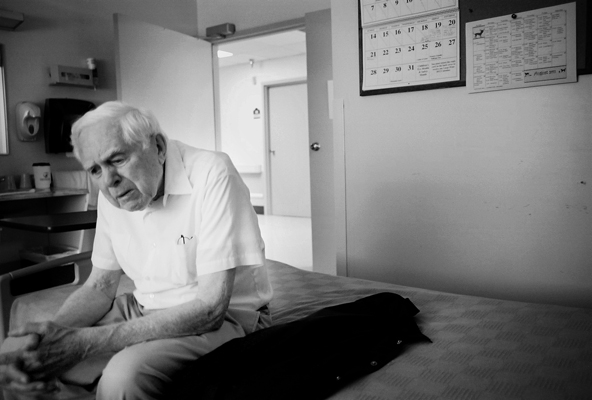
This is a picture of my father in his room at a local nursing home.

I imagine that sentence, illustrating that picture, brings a wave of reaction. Some of you, I hope, are going to give me the benefit of the doubt here, and wait until you read the rest of this. As for those who've already made up their minds, well I dunno.' You can only think what you think.

He's 89, a retired college professor and president. He spent 30 years working for higher education groups in Washington, DC, before moving with us to Lexington to enjoy a quiet retirement.

Unfortunately for him, the move also came shortly after my mother was diagnosed with Alzheimer's. He spent 16 years caring for her in ever greater ways, until finally moving her into a local nursing home for 24-hour care. Then he visited every day, sitting with her for hours. It was only at the very end -- she died in 2007 -- that he began to reduce the time he spent there, as she had essentially ceased to react at all.

Now, nearly 90, he's begun to show signs of dementia. Still functional and alert, he nonetheless lacks short-term memory. I explain to people that he seems on a 30-minute reset.

He focuses his attention, his hopes, his anxieties, his desire for attention, his dependency on me, an only child. Time passes quickly for him, or not at all. For me, it is on an infinite loop.

It's a truism that as one ages, gains responsibility, becomes a parent, one learns how ignorant we all are in childhood, in youth. I never really understood how much stress my father drove himself under until now. It's not that as I deal with the stresses of earning a living, of parenthood, of caring for elderly parents, I sympathize or understand. He seems to carry more.

"Mae," he said to me recently, referring to my mother, "always called me a worrywart." When he lived with us, as his symptoms increased, he would continuously wander about the house, fretting and moving things in an effort to "help" or "tidy up." Sometimes it made sense, as when he would move the children's toys from the living room to their playroom. Sometimes not. Interesting things would sometimes end up in the refrigerator or freezer.

He complained of being "lonely" and feeling trapped. He would appear, like the ghost of unconfessed sin, hovering about in some sort of expectation at regular intervals. When he stood one night after dinner and turned to Jennifer to announce, "My legs won't work," it was almost a relief to check him into the hospital for observation.

Now, in a local nursing home, I visit daily. At first, he complained of elaborate conspiracies in "the administration," forcing him to be careful what he said. Questioning revealed Byzantine details of competing forces between groups in favor of rigid rules and others wanting a more open approach to education.

Yep, education. It took a good hour of listening, in between demands that I bring him home immediately and accusations that I didn't care, before that came up. Turned out, in his mind, he was forced to chair any number of committees, committees he didn't really want to work on because they were dealing with such delicate, stressful issues. Anything he might say would alienate or infuriate some faction. He had driven himself so long, so hard, constantly under such stress, that he now can't function without it. Now in a place where nothing, literally nothing is required of him, he has to create stress.

With this comes a form of blackmail. At irregular but frequent intervals, he puts on his most reasonable face and asks in his most appealing tones if, perhaps if it's possible and it wouldn't be too much of a disturbance, he might join our family and maybe, but only if it wouldn't be too much of a problem, live with us. Often this escalates to a moment much like that in the picture, teary and childlike, convinced that he is "unwanted."

This picture is agonizing to me. Oddly, this is one of the reasons I really like it. It generates a visceral reaction in me; it summarizes the personal pain, the intense desire to do something, while simultaneously understanding that there is little I can do. To bring him home means to take on a full-time job of caregiving, one I do not have the time to do with a full-time job to earn an income (insufficient as it is) and to care for two children. I just do not have the time to entertain that hovering figure of unconfessed sin, let alone deal with physical emergencies on the scale of that night we went to the hospital.

But it makes me think. It makes me think I should write a letter, a real letter like we used to write. I'll use one of my old manual typewriters, address it to my daughters, and begin it: "Dear girls."

In it, I hope to explain that I understand what it's like to care for an old parent, to feel the pull of obligation to do whatever it takes at whatever cost, no matter how hard the contervailing pull of job and family and of all the other demands of daily life. I know about the juggle, and I hope that I am a help rather than a hindrance, as I know my father once hoped to be a help rather than a problem. I think he still hopes that, as he says it, in his way.

But here's the point: I absolve you. I don't want you, no matter how pathetic, manipulative and demanding my words at the time are (and I know they will be; at 5 I was a narcissistic, self indulgent little brat, and I'm positive that's who I'll become again) you should feel free to ignore me, lie to me and otherwise shove me to the back burner. You have your life to live. I had mine. I won't drag you down.


Afterword: It's taken a remarkable amount of time to write this. Despite the date it's marked with, I've only finished on October 11. Much of it is from the time consumed as I describe it here, but much also from the need to compose well, to think about just what I wanted to say and how exactly to say it. In a way, I want to be understood. However, I also can't explain why I want to write this in the first place. Why do I care if others know this?

Here's a theory: it's because I do really like that picture.


Saturday, August 27, 2011

"Of all kinds of birds, of all kinds of beasts, and of all kinds of creeping things, two of each shall come into the ark with you, to stay alive. Moreover, you are to provide yourself with all the food that is to be eaten, and store it away, that it may serve for you and for them." This Noah did; he carried out all the commands that God gave him.

-- Genesis 6:20-22

Later, we learn that Noah was afloat 150 days or so. One hundred and fifty days worth of supplies for eight people (Noah, his wife, and three sons and their wives) and all the animals of the earth. Now the ark was a damn big boat, but can you imagine what it was like on Day One, with all that stuff stacked up everywhere? I'm beginning to sympathize.

We moved recently, and it was as usual a panic. No move in my adult life has been organized or calm. They're always planned to be, but in the end there's inevitably a house full of stuff still, and I find myself tossing things into any box available in the middle of the night before the morning I have to be out. Then there comes the phase we're in now: living in a warehouse.

All those boxes, all that stuff, has to go somewhere, and as we have been downsizing with each move lately, there's more stuff than house right now. Hallways, porches and living areas are stacked high with boxes. Business files share corners with delicate china, boxes full of random kids' drawings sit atop ... well, I'm not really sure what's in that one, but it seems to be very carefully wrapped in newspapers.

The other day, as I slid sideways between to towering walls of boxes in the central hall, it occurred to me that this was like being on a boat at the start of a long journey. Nuclear submarines, for example, gain headroom in their gangways as their months-long deployments go on, as supplies are stored under the removable deckplates. As the food gets eaten, the deck lowers.

But this seemed more than that to me. (And, yes, I am putting the best mental spin on this I can -- I have to stave off the depressing knowledge of how this came to be and what I have to do yet somehow.) It seemed to me to be the chaos of the ark, when the supplies to feed every creature on the earth for an unknown period had to be stowed on a primitive -- big, but primitive -- ship.

Seriously, picture the situation. Bad enough to have every sort of creature pooping and just generally stinking the joint up (I try to imagine the smell of a barn or a zoo, enclosed), but also all the supplies, stacked everywhere. It helps me pretend things aren't so bad...


Monday, July 25, 2011

A Short One ...

So I'm out the other day with Bob Grebe shooting a short feature on the nearly 100-degree weather. We go to the Mill Mountain star, which has an overlook providing a perfect view of the haze hanging over Roanoke below.

On the deck, among other signs, there's a small one giving the address for a webcam attached to the star, which provides a view of the deck. Bob calls his Mom in Pennsylvania, who goes to the site. As I'm shooting the view, I hear this in the background:

"No, it's just me and my photographer ... Yes, he's wearing a jacket ... No, I don't know why."

Tuesday, July 12, 2011

The Way I Live Now ...

So I'm in Cy Twombly's studio, but I'm forbidden to make any pictures. I think my head might explode.

Twombly, if you don't know, is one of the great artists of the 20th Century, friend and equal of Robert Rauschenberg and Jasper Johns. He died July 5 in Rome, his home as far as many knew, but I knew differently. Twombly spent about half the year here in Lexington, Virginia, his home town.

I knew he had friends here, a house and a studio. He did many paintings here, and sculptures. He was a regular in local restaurants, and visited openings at local galleries, including one for a show by my wife. He signed the book, and returned later to tell the gallery owner of his particular affection for one of her photographs. (It now hangs at the local hospital, having been bought by the art committee there...)

When I heard of his death, I knew that this was the opportunity to do something right, and I put out a Facebook appeal and started making calls. Eventually, they led me to Butch, Cy's assistant here in Lexington. He painted backgrounds, and did financial stuff, and drove him around (most think Cy never learned to drive), an generally maintained him when in Lexington.

Butch describes himself as a typical Rockbridge redneck, and I think he's not far off. I take real joy in the simple honesty that describes, and Butch is a good symbol for it, even at 62.

He took my call, as he took the call from the local newspaper, and he agreed to meet in the studio itself for an interview. But he said the lawyers had forbidden any pictures of the studio itself. We shot in front of a blank wall, spattered with paint obviously run over the edge of canvas. Naming a local journalist for the weekly paper, he laughingly noted how they would kill to be where we were. "That's not gonna' happen," he said.

It had been a dentist's office in the old days, basically two rooms -- one in front and one in back. In the front, behind tightly shut venetian blinds, roughly eight sculptures stood, painted white like all the others. A large piece laid on a table, painted gold, resembling a tribal mask about --what -- two-and-a-half-feet tall? On one wall, four elevations of a museum in Texas that features Twombly's art.

It was almost more than I could grasp.

Tables filled the remaining crowded space in the front room. Jars of paint of various colors covered the tabletops, about three deep. A palate with paint smeared on it. In the smaller back room, an Indian (?) wardrobe, still in its dark, natural wood color. And the wall where I interviewed Butch, clearly the place where ... well, let's just lay it out there. It was where the Great Man made his Art.

White, it was splattered with paint of various colors. Sharp edges marked where the canvas had been. This was where he painted the giant canvases.

Butch was generous with his time, as everyone who knew Cy had been. And it made for a nice little piece.

Sunday, June 19, 2011

"I do exist"

So this will show me for not writing things down right away, not to mention not posting on the blog more often...

I wake up last night from a dream, a dream I cannot remember now. It was in the early morning hours, the room was dark, but I didn't open my eyes. I hoped that, if I could stay in that soft, comfortable sleepy place, I might drift off again right away. But nonetheless I was very much awake.

I lay with my head at the foot of the bed, because Janey, 5, lay between my wife and me. Down in the empty space beyond her feet, there was more room.

I wish now I could remember the dream. I know it was something extraordinary, in the literal sense, something supernatural if you will. It was one of those dreams where you feel the world beyond the world of cold, waking reality.

Often there's some stress (at least for me) to those dreams, a tension that forces me to seek solutions outside the normal, like in a ghost story. I think there was stress last night, but there was also resolution, a divine rescue, but as I say, I don't remember the dream now in any way but the faintest of emotional echoes.

But I do remember this:

As I woke, I heard Janey's voice. She spoke normally, and I must note that this isn't unusual. A week or so ago, I woke to the charming sound of her giggling with delight in her sleep. Arbitrary words are often spoken. But this morning, I heard her voice in the darkness clearly say, "I do exist."

I knew, as I lay there, conscious but still sleepy and hoping for sleep, that the two were connected, even as I also knew that from outside the words could be as random as the giggle, the product of her dream about, what, some game with her sister? (And a word like "exist" is in her vocabulary, especially as it turns up in video games.)

For me, it was a clear signal, a message that in this time of stress far beyond some spooky adventure in a dream, there is more ...


"Be still and know that I am ..."
-- Psalm 46:10

Thursday, April 21, 2011

Let Us Dance ...


Rehearsal at the Lexington School of Dance in anticipation of the recital in April. I really like this -- shot with the Zeiss 21 on my Leica M4-2, using Kodak BW400CN film -- mostly because I think it has a Robert Frank aspect to it.


I loaded the Leica with some old 800 speed color film for the performance. I was backstage because the show included and Father-Daughter dance, an anecdote-filled experience that perhaps I shall tell later. Here, however, we see a tap number some time before mine, viewed from the wings.


Caty's tap number viewed from backstage. She had to rush off from this for a costume change for our Father-Daughter number later. Caty is to the right, in the rear row, or perhaps best described as second from the left.


And, finally, Caty and, in the shadows to the left, Janey reaching out to her sister. Another dancer has caught me making pictures...

Two performances were scheduled, but on the second night the weather closed in with heavy rain and wind triggering tornado warnings and flooding. The lower level of the theater was flooded, eventually flooding the electrical room and forcing a postponement. I proceeded to claim God had decided one performance by the Daddies was enough, but we have been rescheduled for May.

Sunday, April 17, 2011

There Was A Mighty Wind ...

Meteorologist Jay Webb in the weather center at the station. This is one of the very few times I wish I had shot in color; around him are radar displays in bright reds, yellows and greens, indicating dangerous thunderstorms in the area.

Earlier, a line of storms had generated tornadoes to the south, in Pulaski County. The morning after, reporter Chris Hurst and I were dispatched there for a live report from the scene for the morning show.

The aftermath of the storms left the entire valley shrouded in thick fog. We drove for an hour in a blanket of dawn-lit white. The center of Pulaski proper seemed fine. But for the heavy police presence, one might have thought the town escaped unharmed. We set up by a state police roadblock.


After the morning show, we set out to find the scene of the damage. Local police with the aid of state police had thrown up roadblocks to seal the area off, but we knew more or less where the tornado had struck, and found a road that was open. The scene was devastating.


The white stuff (pink and yellow actually) is household insulation, shredded and blown across the neighborhood when roofs and walls were peeled away from houses.


A teddy bear -- just one of an uncounted amounts of personal possessions scattered about. In the news business, there is a certain standardization to this sort of thing, a regularity to the randomness of disaster. You can count on the unbroken window in the only remaining wall of a destroyed building, or the yard chair tidily deposited in the tree branches. But perhaps the cruelest thing of all is the casual smearing about of the flotsam of life, all that stuff either tidily packed away or perhaps thoughtlessly tossed in a drawer. Now it's everywhere, covered in mud, pitted and bent and soaked with rain: a picture of Mom here, a towel there. And there's always a teddy bear.

Unfortunately, even in color, the brown bear didn't really pop against the muddied background, making it hard to figure out what it was in a short look, so the shot didn't make it to TV. I'm not sure that it's that good a still, either, but I cling to it for some reason...


After filming in Pulaski proper, we headed out to Draper, a small town out in the county. Chris had been out there the night before, when the storms were still raging (he was operating on about two hours sleep as we worked). "I want to show you something," he said insistently as we drove out of town. We went to the Draper exit from the interstate, where a hollow (pronounced, as a general rule, "holler," around here) had been hit by the storm. Trees all down the hillside had been sheared and pushed over.

But now it was a tourist attraction, with a constant series of cars pulling up to stare, people parking to climb out, gawk at the scene, and take pictures with their cell phones. Across the highway, a gas station had been utterly destroyed, but it didn't draw the attention of the cutoff trees in the tiny valley.

We parked the car at a sheriff's roadblock and walked in to the scene of a trailer home that had been lifted from its foundations, reduced to its component parts, and then deposited some 20 feet away.

It's hard to wrap your head around a loss at this scale. Fortunately, the owner was out at dinner when the tornado struck, and was left unscratched. But everything he owned, all of his physical life, had been crushed, scattered and soaked.

I often try to put myself in the place of story subjects. I think we all do: How would I have escaped the killer? Where would I have taken shelter from the flood? How could I cope with the loss of ... everything? I don't know. Oddly, it reminds me of the challenge of cleaning an out of control, cluttered room. I often find myself paralyzed by the enormity of the task; where to begin? Where does this guy begin?